
Info for Owners
Info for Event Managers
Info for Transporters
Info for Veterinarians
Screwworm
State Resources 6/18/2026
CLICK HERE FOR MORE SCREWWORM RESOURCES
All questions regarding international animal movement as it relates to Screwworm can be answered at www.screwworm.gov
Additional Resources
Map of Current Outbreak : https://www.aphis.usda.gov/node/7944/current-status?page=1
Horse Owner Fact Sheet: https://equinediseasecc.org/handler/managedfilehandler.ashx?id=62&ext=pdf
USDA Myth Buster – Facts About NWS : https://www.aphis.usda.gov/sites/default/files/nws-myth-busters.pdf
USDA New World Screwworm Webinar for Animal Industry https://www.youtube.com/watch?v=0ZdBU0mBXKE
UPDATED 07/22/2026 3:05PM EST

Beyond Screwworm: USDA Says USMCA Trade Talks Now Driving US-MX Border Reopening
The American Horse Council (AHC) continues to monitor developments affecting equine movement between the United States and Mexico.
The U.S.-Mexico land border remains closed to the import and export of livestock, including horses. As a result, horses cannot enter the United States from Mexico by land, and horses in the United States also cannot cross into Mexico. Horses may still enter the United States by air under existing import requirements.
When closure of horses entering the US was first announced, USDA explained that it was intended to reduce the risk of New World screwworm entering the United States from Mexico. Since then, the situation has evolved. Mexico continues to manage outbreaks, and New World screwworm has now been detected in the United States. Despite this, the restrictions on land movement remain in place.
Further, when exports to Mexico were closed in 2026, stakeholders had been informed it was to help contain the spread of screwworm, despite both countries now being affected.
Tens of thousands of horses cross the US-Mexico border annually. The continued closure is particularly frustrating for the horse industry because the United States has safely imported and exported horses between New World screwworm-affected countries for decades under established USDA protocols that include veterinary inspections, treatment requirements, and quarantine. These measures have successfully protected U.S. animal health while allowing international equine movement to continue. Given those existing safeguards, many in the industry have questioned why comparable risk-based protocols are not being used to allow horses to cross the U.S.-Mexico land border.
At the American Horse Council Conference in Washington, D.C., this June, USDA Deputy Secretary Stephen Vaden provided new insight into the situation. He shared that while animal health remains an important consideration, the border is now expected to remain closed until ongoing trade negotiations related to the United States-Mexico-Canada Agreement (USMCA) are completed.
Alarmingly, in a separate import/export equine stakeholder call in early June with USDA, USDA staff could not confirm the border would reopen in the next 6 months.
The USMCA is the free trade agreement between the United States, Mexico, and Canada that replaced the North American Free Trade Agreement (NAFTA) in 2020. The agreement governs trade among the three countries and requires a joint review every six years to determine whether it should be renewed or updated.
On July 1, the Office of the U.S. Trade Representative announced the results of the first required joint review. While the United States did not agree to extend the agreement in its current form, the USMCA remains in effect as negotiations continue with Canada and Mexico to address outstanding issues before considering an extension. Additional bilateral negotiations between the United States and Mexico are expected later this month.
For the equine industry, this means there is currently no announced timeline for reopening land border crossings for horse movement. The continued closure affects horse owners, breeders, competitors, racing, sales, breeding operations, tourism, and other equine businesses that rely on cross-border transportation.
The American Horse Council will continue working with USDA and other federal partners to advocate for practical solutions that protect animal health while restoring the movement of horses across the U.S.-Mexico border as soon as conditions allow. We will continue to keep members informed as new information becomes available.
UPDATED 06/08/2026 3:30PM EST
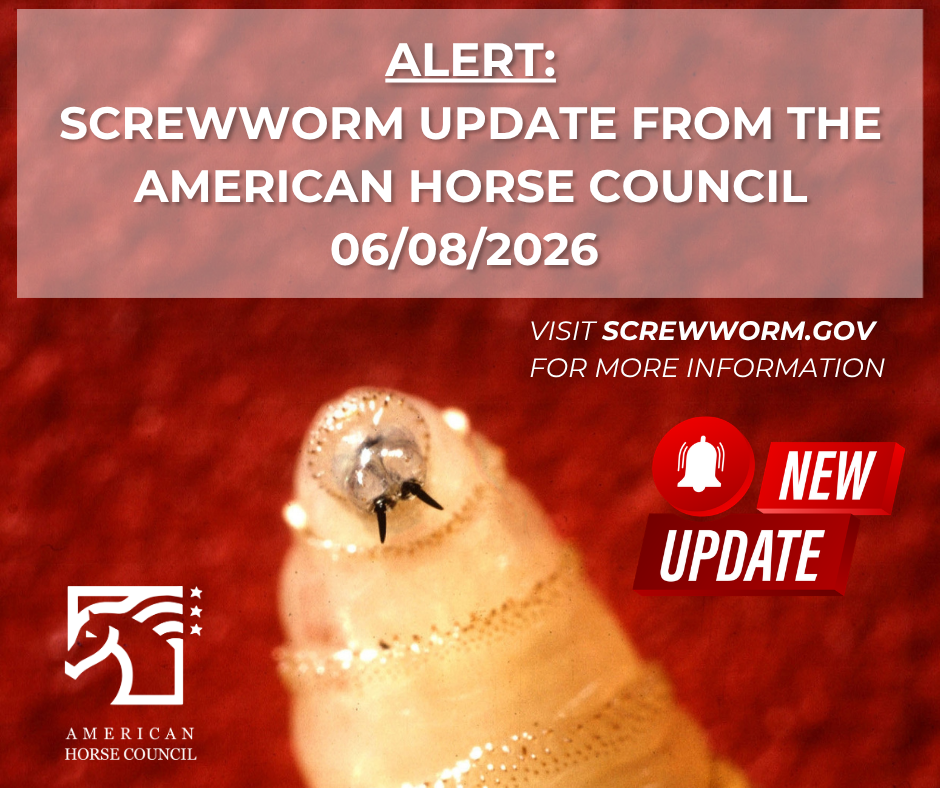
Screwworm Alert from the American Horse Council
As of June 8, 2026, there have now been multiple New World Screwworm detections in Texas, with one being in a county bordering New Mexico. Livestock movement restrictions are in place in Texas and information can be found here: https://www.tahc.texas.gov/
Currently, the US-Mexico border is closed to all livestock exports from the US to Mexico for any reason. This includes all horses. All livestock imports from Mexico to the US are still closed as well. Further, Canada is now restricting all imports of any livestock, including horses, from Texas, and prevents any livestock from entering Canda that have resided in or transited Texas in the previous 21 days prior to importation to Canada.
All questions regarding international animal movement as it relates to Screwworm can be answered at www.screwworm.gov
Additional Resources
Map of Current Outbreak : https://www.aphis.usda.gov/node/7944/current-status?page=1
Horse Owner Fact Sheet: https://equinediseasecc.org/handler/managedfilehandler.ashx?id=62&ext=pdf
USDA Myth Buster – Facts About NWS : https://www.aphis.usda.gov/sites/default/files/nws-myth-busters.pdf
USDA New World Screwworm Webinar for Animal Industry https://www.youtube.com/watch?v=0ZdBU0mBXKE
UPDATED 06/04/2026 5:25PM

Screwworm Alert from the American Horse Council
The American Horse Council (AHC) is working to share critical information for horse owners regarding the current New World Screwworm (NWS) infestation recently announced in Texas.
On June 3, 2026, the U.S. Department of Agriculture confirmed New World Screwworm in the umbilical area of a calf in Zavala County, Texas. This expansion into the United States is alarming and AHC wants to make sure you know about the potential risks of this parasitic fly to horses.
While this might seem like an overwhelming and scary situation, we’ve dealt with this before and have confidence in current science based strategies. The United States historically was afflicted with Screwworm for hundreds of years before successfully eliminating it from the country in the 1960s using many of the same methods we use now.
We’ve eliminated it before, and have full faith we’ll do it again, but only if all horse owners do their part to stay vigilant and follow state guidelines for animal movement.
What is the risk of screwworm to horses?
Screwworm myiasis (infestation) is caused by fly larvae (maggots) that feed on living tissue of any warm-blooded animal. Horses, cattle, wildlife, pets, and occasionally people could all be affected, which means rapid detection and response are essential. The larvae are deposited on wounds or superficial body cavities such as the nose and sheath of horses, where they feed and grow. Untreated wounds often develop multiple infestations which are more likely to kill the animal.
How serious of a threat is this parasitic fly?
Widespread screwworm infestation could have serious consequences for animal health, agriculture productivity, and the national economy. A widespread outbreak will disrupt livestock movement and trade, increase veterinary and surveillance costs, and place major burdens on producers, animal health officials, and event organizers. Early detection and response is critical to stop the spread.
What can a horse owner do to protect their horses?
Horse owners can protect their horses from screwworm by checking daily for any wounds, drainage, foul odor, or unusual irritation, and by cleaning and protecting even minor cuts as soon as they are found to reduce the opportunities for the screwworm fly.
Consistent fly control, good stable hygiene, and careful monitoring after injuries or surgery can help reduce risk, since screwworm flies are attracted to open wounds and body openings. If a horse develops a wound that worsens quickly, has a bad smell, or contains visible maggots, the owner should contact a veterinarian immediately so the horse can be evaluated, treated, and reported if needed.
How will this screwworm detection in the United States impact equestrian sports?
Federal and state animal health officials will dictate the procedures around screwworm cases. C organizers and participants to be aware of and use the guidance of their related discipline associations and governing bodies such as the United State Equestrian Federation.
Further, competitors need to check their home state and destination state animal health official webpages for any movement requirements.
Horses infected with screwworm or horses in a geographic area with screwworm present are likely to be placed under quarantine. State animal health officials will have the discretion to implement movement restrictions in these situations. States may restrict equine movement and activities such as equestrian events in a geographic area. As this is a recent incursion, the state and federal animal health officials are finalizing the protocols for responding to screwworm incursion. If you live in or are traveling to a state where screwworm has been reported, please visit the website of the relevant state veterinarian for the latest information on screwworm response and prevention.
What is the AHC doing to prepare for a potential screwworm incursion?
AHC is working closely with industry partners and has built this webpage dedicated to screwworm updates. We will also be building a link to all state animal health officials to help you understand movement requirements in your area. For now, please review the following trusted resources for any screwworm related information:
Additional Resources
Map of Current Outbreak : https://www.aphis.usda.gov/node/7944/current-status?page=1
Horse Owner Fact Sheet: https://equinediseasecc.org/handler/managedfilehandler.ashx?id=62&ext=pdf
USDA Myth Buster – Facts About NWS : https://www.aphis.usda.gov/sites/default/files/nws-myth-busters.pdf
USDA New World Screwworm Webinar for Animal Industry https://www.youtube.com/watch?v=0ZdBU0mBXKE